My in-laws changed the locks while my seven-year-old son and I were out buying discounted cereal and dinosaur-shaped chicken nuggets at the Kroger on the edge of town. It was one of those bright Midwest Saturdays where the sky looks scrubbed clean, the neighbor’s American flag hangs lazy on the front porch, and you think the worst thing that can happen is the ice cream melting before you get home. Corbin was in the back seat of our old minivan, kicking his sneakers against the floor, humming the jingle from his favorite cartoon. There was a faded flag magnet stuck to the bumper, fluttering every time we hit a pothole, and I remember thinking, stupidly, that it looked kind of patriotic. I had milk in the trunk and a coupon victory in my purse. For the first half of that drive, my life was ordinary. By the time I pulled into the driveway, it wasn’t.
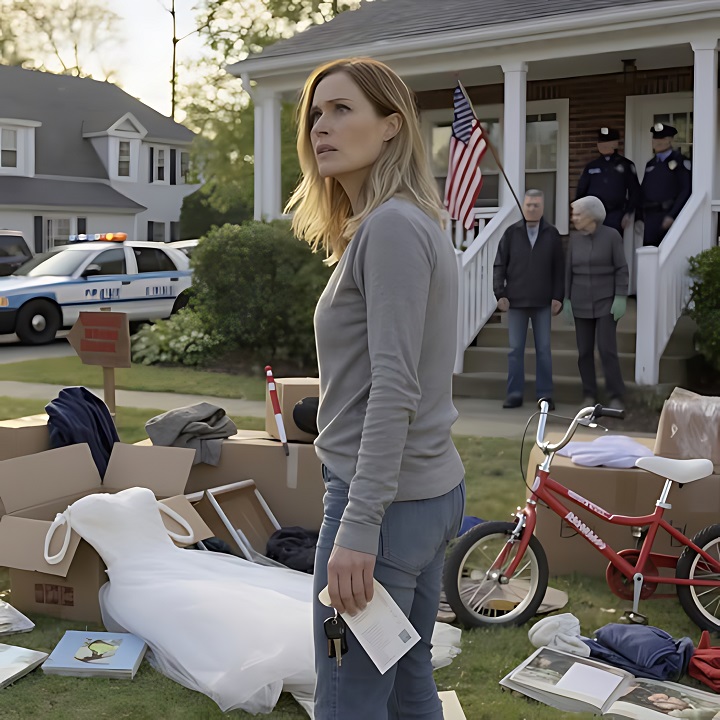
At first my brain refused to process what my eyes were seeing. There were piles on the lawn—clothes, furniture, boxes—spilling down toward the sidewalk as if someone had shaken our life and dumped it out. It looked like a yard sale put together by a cruel person with no labels and no prices. I slowed to a crawl, squinting, and that’s when I saw my own things scattered across the grass like debris after a tornado.
My wedding dress was draped over the city trash can at the curb, the hem dragging in the dirt. The dress I’d worn when I married Neil eight years earlier. The dress I’d sealed in a preservation box because I had this picture in my head of someday showing it to a future daughter-in-law. Now it hung like a rag, one sleeve caught on the cracked plastic handle. Corbin’s bicycle lay half in the street instead of up by the garage, one wheel still slowly spinning like someone had just thrown it and walked away.
I put the minivan in park and just sat there, both hands locked on the steering wheel so hard my knuckles went white. I could hear my own heartbeat pounding in my ears. In the rearview mirror, Corbin pressed his face to the window, his breath fogging the glass.
“Mom? Why is my bike outside?” he asked.
I didn’t have an answer. Not for him, not for myself. My legs felt like they belonged to someone else when I finally forced myself out of the car. Up close, the scene was worse. Family photo albums lay open in the grass, pages fluttering in the breeze. There was Neil and me on our honeymoon in Florida, Corbin as a newborn in his hospital beanie, his first day of kindergarten with a backpack too big for his shoulders. All of it spread out for the neighborhood to see like it meant nothing.
My jewelry box had been upended near the steps. My grandmother’s earrings, the only thing of hers I had left, glinted in the sun, tangled up with cheap costume bracelets. My vet-clinic scrubs, Corbin’s little jeans and superhero T-shirts, our winter coats and summer dresses—every season of our lives thrown onto the lawn like garbage waiting for pickup.
That’s when I saw the sign.
It was a piece of plywood hammered into the center of the yard where the grass was always a little greener than the rest. The letters were bright red, neat, deliberate. Someone had taken their time painting them, maybe at the kitchen table where I used to help Corbin with his homework.
FRELOADERS NOT WELCOME.
I read the words three times before they sank in. My cheeks burned hot even though the air still had a late-winter bite. Freeloaders. That was what they were calling us to the whole subdivision. That’s what they had decided we were after eleven months of me paying on the dot and following every rule.
I didn’t need to check the handwriting to know who had done it. My mother-in-law, Darren, had always favored red markers for her chore lists and holiday menus, like urgency in ink.
The front door opened with an easy swing I suddenly didn’t have access to. Darren stood there in the doorway of the house where I had been living for almost a year, wearing gardening gloves and a pleasant expression, like she’d just finished planting petunias instead of detonating my life.
“Oh, Tessa,” she said, voice soft and syrupy. “I was hoping you’d find somewhere else to go before we had to have this conversation.”
For a second no sound came out of me. Words were piled somewhere between my chest and my throat, blocked by shock and a fury so sharp it felt like grief all over again. Corbin darted past me before I could react. He lunged for the wet grass and scooped up his stuffed dog—a ratty, worn-out thing he’d slept with since he was two. He clutched it to his chest, lower lip wobbling, and then the sobs started.
The sound of my son crying snapped something loose inside me.
“What have you done, Darren?” I asked, my voice lower than I expected. “What is all this?”
She smiled, the kind of cold smile that never reaches the eyes, the kind I’d seen flashes of over the years but had always explained away as stress or generational differences.
“I’ve done what I should’ve done months ago,” she said. “You’ve taken advantage of our generosity long enough.”
I need you to understand something before we go any further. I had paid this woman $1,200 every single month to live in that house—because she insisted on it. I’d worked double shifts at the animal clinic, giving baths to anxious Labradors and holding the paws of old cats going to sleep, to make sure I never missed a payment. I cooked meals, cleaned common spaces, and followed every arbitrary rule she came up with. I bent over backward to be a good guest in her home.
And yet there I was, standing in the yard next to a sign calling me a freeloader.
“You can’t be serious,” I said. “I’ve paid you rent. Every month. In cash. Just like you wanted.”
Darren tilted her head, her expression shifting into the kind of faux pity that used to make me feel ten inches tall. “I don’t know what you’re talking about, Tessa,” she said. “We’ve never received a penny from you. Vance and I have been paying for everything while you… get back on your feet.”
The lie was so bold it punched the air out of my lungs. She had taken those envelopes from my hand on the first of every month. Some months she’d even counted the bills at the kitchen counter, chatting about the weather while her thumb flicked through the twenties.
Behind her, my father-in-law, Vance, appeared in the hallway. He looked at the floor, then at the ceiling, then at the far wall—anywhere but at me. He didn’t say a word.
“Darren, please,” I said. “My son is right here. He’s watching this.” I nodded toward Corbin, who was hugging his damp stuffed dog so tightly his knuckles were as white as mine had been on the steering wheel. “Can we at least talk inside like adults?”
She glanced at Corbin, then back at me. Her face didn’t soften.
“Children are resilient,” she said. “What he needs is stability. And frankly, Tessa, you haven’t been providing that.” She peeled off one gardening glove with theatrical slowness. “Now, I’m giving you fair warning. If you don’t clear your things off my lawn and leave, I’ll call 911 and report you for trespassing.”
“Trespassing?” I repeated. “In the house I’ve been paying to live in for almost a year?”
Her smile thinned. “This is my house,” she said. “Neil bought it for us. You were always just… temporary.”
The word temporary hit harder than I wanted it to. For a dizzy second I could feel Corbin’s eyes on my back, could almost hear the neighbors shifting behind their curtains. Two doors down, Mr. and Mrs. Henderson stood on their porch beside their own neatly folded Stars and Stripes, pretending to check their mail while openly watching the show.
I knew if I stayed one more second, I would break in a way my son didn’t need to see. So I swallowed the scream clawing up my throat, grabbed Corbin’s free hand, and walked him back to the minivan.
We drove away from the only place that felt even halfway like home with the trunk full of groceries and the words FRELOADERS NOT WELCOME burning red in the rearview mirror.
My name is Tessa Bernie. I’m thirty-three years old, a vet tech in a small Ohio town, and for five days after that sign went up, I believed I’d been evicted from a house that didn’t belong to me. What I didn’t know yet was that the real trespassers were standing on that porch—and that every brushstroke of Darren’s red paint was about to become evidence.
It took five days, one furious aunt, and a property attorney who smelled like coffee and old paper to flip the story completely. But to understand how I got there, we have to rewind eleven months—to the day my husband’s name showed up on a state trooper’s caller ID and my world split in half.
Neil left for work on a cold February morning that started out like any other. Snow was in the forecast, but nothing unusual for Ohio in winter—just enough to close the school early and make the roads a little slick. He kissed me goodbye in the kitchen while I was packing Corbin’s lunch. Peanut butter and jelly, no crusts, apple slices squeezed into a plastic bag that never quite sealed.
“Pizza for dinner?” Neil asked, snagging a grape off the counter.
“Only if you survive the interstate,” I teased, bumping his hip with mine. “Corbin’s vote is pepperoni, extra cheese.”
Corbin came skidding into the kitchen in socks, hair sticking up. “Pepperoni and extra cheese,” he repeated, like a binding contract.
“Pepperoni and extra cheese,” Neil said, kissing the top of his head. “Got it, buddy.”
Those were the last words I ever heard him say.
The call came four hours later while I was loading the dishwasher and half-listening to an old Frank Sinatra playlist humming from the smart speaker. When I saw an unknown number from a county two over, I almost let it go to voicemail. I’d been getting spam calls from fake 911 charities for weeks. Something made me answer.
“Mrs. Bernie?” a man’s voice asked. “This is Trooper Haskins with the Ohio State Highway Patrol.”
My hand went cold around the phone.
He told me there had been a multi-car pileup on I-71 when a semi jackknifed in a sudden whiteout. Neil’s car had been in the wrong place at the worst possible second. They’d rushed him to the ER. The paramedics had worked on him all the way there. “He didn’t suffer,” the trooper said, like that was a gift he could hand me over the line.
I don’t remember hanging up. The next clear memory I have is of sitting on the kitchen floor with Corbin’s snack cup overturned beside me, Cheerios scattered like confetti, my heart pounding so hard I thought maybe I should call 911 for myself.
The weeks after the funeral exist in my mind like a broken film reel—jagged, out of order, full of missing frames. I remember faces at the service but not names. I remember casseroles appearing in my fridge, aluminum foil labeled in looping church-lady handwriting. I remember Corbin asking when Daddy was coming home and the way my mouth wouldn’t form the words never.
Neil had always handled our finances—the mortgage on our old apartment, the bills, the insurance, all of it. “I don’t want you stressed over money,” he’d say. “I’ve got us.” It sounded romantic when we were twenty-five and healthy. At thirty-two and newly widowed, it felt like trying to read a language I’d never learned.
Six weeks after the funeral, my mother-in-law showed up at my apartment building with a casserole dish cradled in her arms and a look of earnest concern on her face.
“Sweetheart, you can’t keep going like this,” Darren said, settling onto my couch like she owned it. “You’re barely functioning. Neil would be devastated to see you and Corbin struggling this way.”
She wasn’t wrong. I was a ghost in my own life. I’d taken a leave from the clinic. I wasn’t sleeping. The apartment was full of Neil—his coffee mug by the sink, his coat on the hook by the door, his smell in every room. I could barely walk past the laundry basket without falling apart.
“Move in with us,” she said, laying a manicured hand on my knee. “We have plenty of room. Vance and I would love to have Corbin close. It’ll give you time to heal, to figure things out. It’s what Neil would have wanted.”
My relationship with Darren had never been warm. Over the years she’d made comments about my cooking, my housekeeping, my job. Little jabs wrapped in sugar.
“Vet tech, huh?” she’d say. “Such a sweet calling, even if it’s not exactly… lucrative.”
But grief makes you grab the closest life raft, even if you can’t tell whether it’s wood or stone.
I said yes.
I sold most of our furniture and packed the rest into storage. Corbin and I moved into the upstairs bedroom of the Bernie family home—the one with the sloped ceiling and the view of their maple tree out front. It was supposed to be for a few months, just until I got back on my feet.
From the very first week, I insisted on paying rent.
“I can’t let you do that,” Darren said at first, patting my cheek like I was a child. “You’re family.”
“It’s important to me,” I told her. “I need to know I’m pulling my weight. I don’t want to feel like a burden.”
She sighed, as if I were twisting her arm into something painful. “Well, if it makes you feel better,” she said after a moment, “$1,200 a month seems fair, don’t you think?”
I agreed without shopping around or looking anything up online. I was just grateful to have a roof over our heads and someone else willing to mow the lawn.
“Cash is easier,” Darren added, almost as an afterthought. “Less paperwork for everyone. We don’t want to get the IRS involved over family, right?”
So on the first of every month, I handed her an envelope with $1,200 in it. Sometimes she tucked it into her purse without looking. Sometimes she spread the bills on the kitchen counter, counting them with practiced fingers while I stirred spaghetti sauce.
I never asked for a receipt. I never made a note in a spreadsheet. I never imagined I’d need proof against the woman who’d watched me say my vows.
The first few weeks weren’t terrible. Darren cooked dinner most nights. Vance taught Corbin how to put together a thousand-piece puzzle at the dining room table. There were nights when the house felt almost cozy, like a second chance at family instead of a hospital waiting room I’d moved into.
Then, slowly, the temperature shifted.
Darren started correcting the way I loaded the dishwasher. “Plates like this, dear. Neil always liked them facing inward.” She rearranged my groceries in the fridge because I’d put them in the “wrong” spots. She told Corbin he was too loud when he played in the backyard, so he stopped playing outside at all.
“Neil never would’ve let Corbin carry on like that,” she’d murmur, loud enough for me to hear. “Neil kept a much tidier place than this. He must be watching from heaven, wondering what happened to his home.”
Every comment was a paper cut, small and almost deniable, but together they added up to something raw.
My Aunt Opal called once a week, like clockwork. She’s my mother’s younger sister, the woman who took me in when my parents died in a wreck when I was sixteen. She’s the kind of woman who keeps every receipt in a labeled envelope and whose laugh can fill a church basement.
“How are things with the Bernies?” she’d ask.
“Fine,” I’d say, twisting the phone cord around my fingers out of old habit even though it was cordless. “They’re just… set in their ways.”
“Something about that woman has never sat right with me,” Opal said more than once. “Be careful, Tess.”
“I’m fine,” I’d insist. “She means well. She’s just old-school.”
I wanted that to be true so badly I treated it like fact.
The morning of the lockout started like any other Saturday. I woke up early, made Corbin pancakes in the shape of Mickey Mouse ears, and circled items in the grocery ad—a sale on his favorite cereal, a buy-one-get-one on apple juice. I figured we’d make a little adventure out of it, maybe swing through the drive-thru for fries on the way home.
Darren was at the kitchen table when we came downstairs, a mug of coffee cradled between her hands, the local paper folded beside her. She didn’t look up when I told her we were heading out.
“Going somewhere?” she asked, eyes fixed on something outside the window.
“Just to Kroger,” I said, grabbing my keys from the hook by the back door. “We’ll be back in a couple hours.”
She nodded, lips pressing into a thin line. “Take your time,” she said.
If there had been any warning in her voice, any crack in the calm, I missed it. I was focused on coupons and keeping Corbin from sneaking a second donut into the cart.
We were gone less than two hours.
And when we turned back onto Bernie Street, normal ended.
You already know what I found when we pulled up—the dress, the bike, the photos, the sign. What I didn’t tell you yet is how it felt to walk through that mess, picking pieces of my life out of the dirt while people I barely knew watched from their porches.
Corbin’s baby book lay open near the mailbox, pages warped from the sprinklers. Photos of his first steps and first tooth curled at the edges. A crayon drawing he’d made of our family—three stick figures, one tall, one medium, one small—was plastered against the curb, the ink bleeding.
I scooped it up and held it to my chest, as if body heat could undo water damage.
Across the street, a neighbor I’d waved to a dozen times clutched a travel mug and stared. I found out later that Darren had done a whole tour of the street that morning, explaining that I was being “legally evicted” for stealing from her. She spent hours painting her version of the story before I even knew I was a character in it.
After Darren threatened to call 911, I left because I didn’t know what else to do. I buckled my sobbing child into his booster seat, backed out of the driveway I’d helped shovel all winter, and parked around the corner, out of sight of the house, because I needed somewhere to fall apart.
My hands were shaking so badly I could barely tap the right contact on my phone.
Aunt Opal answered on the second ring. “What’s wrong?” she asked immediately. She always skipped hello when something was really wrong.
I told her everything in jagged pieces—the lawn, the sign, the lie about the rent, Corbin’s bike in the street.
“Stay put,” she said. I could hear car keys jingling in the background. “I’m leaving now. Four hours, tops. And listen to me, Tessa—don’t you dare let that woman see you cry again.”
When Opal’s dusty silver pickup finally pulled into a motel parking lot off the highway that evening, the sun was setting behind the Walmart across the street. We’d already gone back to the house once, quickly loading whatever we could into trash bags—clothes, a few toys, the least-damaged photo frames—while Darren watched from the bay window, arms folded. Some things were beyond saving: the quilts my mother had made, several of Corbin’s drawings, and most of the photo albums.
That night, in a room that smelled like industrial cleaner and old cigarettes, Corbin curled against my side on the lumpy queen bed. The floral bedspread scratched at my arms. I stared at the popcorn ceiling while the motel AC clanked on and off.
“Mom?” Corbin whispered in the dark.
“Yeah, buddy?”
“Are Grandma and Grandpa mad at Daddy in heaven too?”
The question sliced through me cleaner than any insult Darren had ever thrown.
I pulled him closer and kissed his hair. “No,” I said, my voice catching. “They’re just… confused. This isn’t about Daddy. This is about grown-ups making bad choices.”
I didn’t fully believe my own words yet, but I needed him to sleep.
He finally drifted off, one small hand fisted in my T-shirt. I lay awake, staring at the cheap artwork bolted to the wall, feeling something hot and electric building beneath all the fear.
Anger.
Three days after the lockout, Opal and I sat at the motel’s wobbly little table. Corbin was asleep again, cartoons still playing on low volume because I didn’t have the heart to turn them off.
Opal had a yellow legal pad in front of her covered in her tight, looping handwriting. Her years working as a court clerk came back like muscle memory; she made columns and arrows and little stars in the margins.
“Something about this doesn’t add up,” she muttered for the third time, tapping her pen. “How exactly did Neil’s parents end up in that house in the first place?”
I rubbed my temples. Exhaustion made everything blurry. “He mentioned once that his grandmother left some money when she passed,” I said slowly. “That was a couple years before he died. He said it helped them ‘get settled.’ I figured he meant they used it to move or pay off debt. He didn’t like talking about money with me—it stressed him out.”
Opal leaned forward. “Did he ever say they bought the house?”
“I… don’t remember,” I admitted. “We were always renting. At least I thought we were.”
Opal’s gaze sharpened in a way I’d seen in courtrooms when a witness accidentally said too much. “I remember him saying something at his grandmother’s funeral,” she said. “He told me he was relieved because now he could finally ‘take care of things properly.’ He sounded proud, like he’d done something big.”
“Like what?” I asked.
“Like buying property,” she said flatly. “Tessa, what if Neil bought that house?”
The idea seemed too big to fit in the motel room. I shook my head automatically. “He would’ve told me,” I said, then winced because even to my own ears, it didn’t sound certain.
Opal tapped her pen again. “Maybe he planned to. Maybe he was waiting until everything was official. Either way, if he bought it, there will be a trail. Deeds filed. Taxes paid. And if he died without a will, Ohio law says…”
“That everything goes to the spouse,” I finished quietly. I might have been bad with details, but I wasn’t completely clueless.
“And if that’s the case,” Opal said, “then your in-laws have been charging you rent on your own house.”
The idea made my stomach flip.
The next morning, Opal started calling people. She still had friends at the courthouse, people who knew where records lived and which offices answered their phones faster if you mentioned the right names.
By noon she’d scribbled a name at the top of a fresh page: KIRBY ANSELM.
“Property attorney,” she said. “Specializes in estate messes and real estate fraud. I worked with him on a couple of nasty cases back when I was clerking. He’s agreed to see us tomorrow.”
Kirby’s office was in a squat brick building downtown, wedged between a same-day tax-prep place and a dry cleaner. The waiting room smelled like coffee that had been cooking on a burner since 6 a.m. and paper that had seen better decades.
He was tall, in his late forties, with graying hair and wire-rimmed glasses he kept pushing up his nose. His desk was a battlefield of manila folders and sticky notes, but he moved through it like a man who knew exactly where every piece of ammunition was stored.
“Tell me everything,” he said, flipping open a legal pad. “Start from when your husband passed.”
So I did. I told him about Neil’s accident, Darren’s casserole and offer to move in, the cash rent, the lockout, the sign. I told him how she’d stood in the doorway of that house with gardening gloves on and called me a freeloader.
Kirby didn’t interrupt, not once. His pen scratched quietly across the page.
When I finished, he sat back and studied me for a long moment.
“Mrs. Bernie,” he said finally, “did your husband ever mention purchasing property? Any property at all?”
“No,” I said. “But my aunt thinks he might have bought the house his parents are living in.”
Kirby nodded slowly. “That would track with what she remembers from the funeral,” he said. “Here’s the thing: if your husband owned that house and died without a will that said otherwise, state law is very clear about who it belongs to now.”
“Me,” I whispered.
“You,” he agreed. “Let me pull some records—county deeds, mortgage filings, probate documents. If Neil owned that property, there will be a paper trail.”
He stood and shook my hand. “Give me forty-eight hours,” he said. “I’ll call you when I know something.”
Those two days were some of the longest of my life. Every time my phone buzzed, my heart tried to jump out of my chest. I barely slept. Corbin kept asking when we were going “home,” and I didn’t know how to tell him I didn’t know where that was anymore.
On the morning of day four, Kirby called.
“Mrs. Bernie,” he said, and there was something in his voice I couldn’t read. “I need you and your aunt to come to my office. Today. You’re going to want to sit down for this.”
Opal and I were there within the hour. There were more papers on his desk this time, spread out in a fan like a magician about to reveal a trick.
“Before I show you these,” he said, “I need to ask—did your in-laws ever give you any paperwork after your husband’s death? Anything about his accounts, assets, or the estate?”
I shook my head. “They said there wasn’t much,” I said. “A little savings that went toward funeral costs. They offered to ‘handle the boring stuff’ so I could focus on Corbin.”
Kirby’s jaw tightened. “Your mother-in-law lied to you about everything,” he said.
He slid a document across the desk toward me. It was a property deed, dense with legal language. But in the middle, clear as day, was a name.
NEIL ANDREW BERNIE.
“Your husband purchased that house three years ago,” Kirby said. “He paid for it in full using his grandmother’s inheritance plus savings. No mortgage. No liens. He is listed as sole owner.”
I traced Neil’s name with my fingertip like it might disappear if I blinked.
“That’s not possible,” I whispered. “He never told me.”
“Based on correspondence I found between Neil and his grandmother’s estate attorney,” Kirby said, “I believe he planned to surprise you. There’s a note here where he specifically requests that his parents not be informed of the details of his inheritance. His grandmother was… concerned about them. She wrote that her money was to benefit Neil and his future family, not her son and daughter-in-law.”
Opal let out a low whistle. “So Neil bought the house and let his parents live there,” she said. “As a favor.”
“As a kindness,” Kirby agreed. “The deed shows your in-laws were permitted to reside there—informally—but they had no legal claim to the property.”
He pulled out another document, this one stamped with an official seal. “Under Ohio intestacy law, when someone dies without a will specifying otherwise, their property passes directly to the surviving spouse. Which means, Mrs. Bernie, that you have been the legal owner of that house since the day your husband died.”
The room tilted. I gripped the arms of the chair until the leather squeaked.
“Eleven months,” I said. “I’ve owned that house for eleven months, and they knew?”
“They knew,” Kirby said. “The probate court notified them. I have copies here of the acknowledgement your mother-in-law signed. She knew exactly who owned that property when she invited you to move in, when she collected $1,200 in cash from you every month, and when she changed the locks and put your belongings on the lawn.”
Opal made a sound that was half gasp, half growl. “That woman charged my niece rent on her own house,” she said. “And then called her a freeloader.”
“What does that mean, legally?” I asked, my voice thin.
“It means,” Kirby said, “that your in-laws have been living in your house without your permission, collecting rent they had no right to, and forcibly removing the lawful owner. That’s fraud. That’s an illegal lockout. That’s theft by deception.”
He tapped a numbers column on his pad. “Eleven months of rent at $1,200—that’s $13,200. Add in a conservative estimate for damaged belongings—say another $2,800—and we’re at $16,000 your mother-in-law effectively stole from you while calling you a parasite.”
Sixteen thousand dollars. That was the price tag on her so-called generosity.
“I’ve already spoken with the county prosecutor’s office,” Kirby added. “They’re interested. They’d like to have a conversation with Darren and Vance. What I need from you is every scrap of evidence you have—texts, voicemails, anything. And those photos your aunt took of the yard? Especially the one with that charming sign.”
That red-lettered board had started as humiliation. Now, in a manila folder on Kirby’s desk, it became Exhibit A.
The next morning, day five, I stood on the sidewalk across from the house with Opal and Kirby. My palms were slick, my heart beating an unsteady rhythm against my ribs. A police cruiser rolled up the street, then another, their blue-and-white paint jobs looking strangely bright against the familiar maples.
One officer stayed by the cars. The other walked up the driveway and knocked firmly on the front door. It took a few seconds and a second knock before Darren opened it, a dish towel over her shoulder like she’d just been interrupted doing something noble and domestic.
Her expression went from confusion to recognition to something I’d never seen on her face before.
Fear.
“Mrs. Bernie?” the officer asked.
“Yes?” she said, chin lifting.
“Ma’am, we need you and your husband to step outside,” he said. “We have some questions regarding allegations of fraudulent collection of rent and unlawful eviction of the property owner.”
Darren’s gaze snapped past him and found me across the lawn. For a moment neither of us moved.
“This is ridiculous,” she said, her voice rising an octave. “That woman has no claim to this house. She’s been manipulating my family since the day she married my son. She’s a liar and a thief.”
The officer didn’t flinch. He unfolded a packet of papers, the official seal catching the sunlight. “Ma’am, county records list your daughter-in-law as the sole owner of this property,” he said. “What we have here is an order for you to vacate pending the outcome of the investigation. You’ll want to speak with your attorney.”
Vance appeared behind her in the doorway. His shoulders seemed to have sunk a full inch since the last time I saw him.
“It’s over, Darren,” he said softly. “I told you this would catch up with us.”
“Don’t you dare,” she hissed, rounding on him. “After everything I’ve done for this family—”
“For this family?” I cut in before she could rewrite the script again. My voice surprised me—it didn’t shake. “You took eleven months of my pay in cash. You threw my wedding dress on the trash can. You left my son’s baby pictures in the sprinklers. You hammered a sign into my front yard calling me a freeloader while you lived in the house my husband bought for us.”
Neighbors were gathering again. The Hendersons stood on their porch, this time without their travel mugs, faces pale. The woman across the street who’d watched earlier now shifted behind her screen door.
Darren looked like she wanted to lunge at me, but the officer’s presence kept her rooted.
“This is still my house,” she said, but even she sounded like she didn’t believe it.
“No, ma’am,” the officer said calmly. “Today it’s evidence.”
They didn’t cuff her—not for this first conversation—but they did escort her and Vance to the cruiser for questioning. Kirby had warned me there might not be dramatic TV-style sirens and a perp walk. Real justice is quieter. But as the car pulled away, I could see Darren’s face through the back window, pale and tight, and something inside me finally unclenched.
The weeks that followed were a blur of hearings and paperwork. Darren and Vance were formally charged with fraud, theft by deception, and illegal lockout. Their attorney tried to spin a story about “confusion” and “family misunderstanding,” but the documents Kirby had dug up told a cleaner story than any of us could.
They had signed probate acknowledgements. They had accepted my cash. They had lied to my face and to an entire cul-de-sac.
In the end, they pled no contest to avoid a long trial.
The judge—an older woman with reading glasses perched low on her nose—wasn’t in a forgiving mood.
“Family doesn’t give you a free pass to disregard the law,” she said from the bench. “In fact, exploiting someone’s grief for financial gain makes this worse.”
She ordered Darren and Vance to pay restitution of $16,000—every dollar of rent I’d paid plus damages for destroyed belongings and emotional distress. She gave them three weeks to vacate the property completely.
I sat in the back row of the courtroom, Opal’s hand wrapped around mine, and watched Darren’s face as the number landed. For once, she didn’t have a comeback. Sixteen thousand dollars. That was the figure that finally shut her up.
They moved out of my house on a gray Thursday while I stood at the end of the block with Opal, watching moving men carry out furniture that technically belonged to me but that I had no interest in ever seeing again. Word on the street was they found a small rental apartment two counties over, closer to Vance’s brother. Darren never reached out. Not to apologize. Not to explain. Not even to spin a new story.
Some people would rather live inside their version of events than step outside and face the truth.
Going back inside the house after they were gone felt like walking into a stranger’s home and a crime scene at the same time. The rooms looked smaller without Darren’s heavy furniture. There were lighter rectangles on the walls where pictures had hung and scuff marks where Corbin’s toy cars had once crashed.
“Mom?” Corbin asked, standing in the foyer with his stuffed dog clutched to his chest. “Is this really our house now?”
I knelt down so we were eye to eye. “This was always our house,” I said. “Daddy bought it for us. He wanted us to be safe here.”
Corbin frowned in concentration, as if rearranging the puzzle pieces in his head. “So Daddy’s still taking care of us?”
“Yeah,” I said, pulling him into a hug. “Even from heaven.”
Later that week, while going through the garage, I found the sign.
Darren hadn’t bothered to take it. It leaned against a stack of paint cans, the red letters still loud and ugly: FRELOADERS NOT WELCOME. The wood was scarred from where the stake had been hammered into the ground.
For a second I wanted to smash it to splinters. Instead, I carried it into the backyard and set it on the patio table. Opal came out with two mugs of iced tea, the condensation leaving rings on the glass.
“You keeping that thing?” she asked, raising an eyebrow.
“For now,” I said. “Evidence, remember?”
She nodded. “Fair enough. Just don’t let it decide who you are.”
A few weeks later, after the last of the paperwork was filed and the restitution check cleared, I took the board to a friend from the clinic whose husband did woodworking on the side. He sanded it down until the red letters were nothing more than a faint ghost beneath fresh primer.
We painted it a soft blue. On a quiet Sunday afternoon, while Corbin watched a game with Opal in the living room, I sat at the kitchen table with a black paint pen and wrote three words across it in my own handwriting.
WE LIVE HERE.
We hung it in the entryway where the mirror used to be.
About a month after we moved back in, I was cleaning out the closet in the bedroom Darren had claimed as her own when I found a dusty cardboard box shoved into the far back corner. It was labeled with Neil’s handwriting—my name on the top in blue ink.
My hands started to shake before I even opened it.
Inside were neatly stacked folders—insurance policies, bank statements, the deed I’d already seen copies of, all organized in a way that made my heart ache with its familiarity. At the very bottom was a plain white envelope with TESSA written across the front.
The letter inside was dated two weeks before his accident.
Tess,
I’ve been working on something for you and Corbin, and you know I’m terrible at talking about money without making us both anxious. So I’m writing it down where I can’t chicken out.
This house—it’s yours. I bought it for us. For you and our boy. There’s no mortgage. If anything ever happens to me, I need you to know you’ll always have a roof over your heads. You’ll always have a place that’s yours.
My parents don’t know I’m writing this, and honestly, I don’t totally trust them to do right by you if I’m not around. So I’m putting it in black and white: this house belongs to you. Don’t let anyone tell you different.
I love you.
Always,
Neil
I sat on the closet floor with that letter in my hands and sobbed until my throat hurt. But for the first time in almost a year, the tears didn’t feel like drowning. They felt like air.
Neil had tried to protect me from exactly what ended up happening. He just ran out of time to hand me the shield.
Opal moved in with us for a couple of months to help us settle. We repainted Corbin’s bedroom in a bright blue he picked from a paint chip wall at Home Depot, a shade he insisted looked “like the sky over Disney World.” We planted flowers along the front walk where Darren’s sign had once stood, marigolds and petunias popping up like little suns.
The neighbors who had watched from their porches that first day started waving again. A few brought over apology pies and awkward explanations.
“We didn’t know,” Mrs. Henderson said, cheeks pink. “Your mother-in-law told us you were… Well. I’m sorry, dear.”
Small towns love a scandal, but they love a reckoning even more.
I went back to the clinic. My coworkers wrapped me in hugs and shoved Tupperware of lasagna into my hands and asked no questions I didn’t want to answer. Someone had taped a printout of a cartoon dog over my locker with the words WELCOME HOME, TESSA written in thick black marker.
Corbin started sleeping through the night again. He stopped flinching when he heard footsteps on the stairs. He made a new friend at school, a kid named Mason who loved dinosaurs as much as he did, and one afternoon he came into the kitchen and asked if Mason could come over and play.
“Here?” I asked, wiping my hands on a dish towel.
“Yeah,” he said, grinning. “At our house.”
Our house.
Two small words that felt like a miracle.
If there’s anything I’ve learned from all of this, it’s that grief makes you vulnerable in ways you don’t see until later. It turns your world into fog, and there are people who will walk into that fog with lanterns and maps and good intentions.
And there are people who will walk in carrying red paint and lumber, ready to put their own name on whatever they can get their hands on.
They will smile at you while they’re stealing from you. They’ll call you family while they’re planning your exit. They’ll make you feel like a burden while standing on ground that legally belongs to you.
So protect yourself—especially when you’re broken. Ask questions. Demand documentation. Keep receipts. Don’t let anyone convince you that wanting proof makes you paranoid. It makes you smart.
And if someone ever throws your belongings on a lawn and labels you a freeloader, don’t disappear. Don’t let their sign write your story.
Stand up. Find the truth. Take back what’s yours.
The board that once screamed FRELOADERS NOT WELCOME now hangs in my entryway, soft blue and steady, with WE LIVE HERE written across it in my own hand. Every time I walk past it, keys in one hand and my son’s backpack in the other, it reminds me of two things.
Who this house belongs to.
And who never gets to change the locks on us again.
Life didn’t magically smooth out after the restitution check and the fresh paint dried. Bills still showed up in the mailbox. Grief still sat on the edge of my bed some nights, heavy as ever. But the shape of my days changed, little by little, until one morning I realized I’d gone a full hour without thinking about Darren’s red letters or that awful afternoon on the lawn.
The first big test came at Corbin’s school.
It was a Friday in late spring, the kind where the air smells like cut grass and sunscreen. The school hosted a “Family Fun Night” with hot dogs, bounce houses, and a silent auction in the gym. I almost didn’t go—I didn’t want to bump into anyone who’d seen our belongings in the yard or heard Darren’s version of the story—but Corbin’s eyes lit up at the flyer in his backpack.
“Please, Mom?” he begged. “They’re gonna have the big slide. Mason’s mom said it’s taller than the basketball hoop.”
I swallowed my anxiety and said yes.
The parking lot was already full when we pulled in. A PTA volunteer in a neon vest waved us toward a spot near the edge. Kids ran in packs, faces painted, glow sticks already trailing in the growing dusk. I could see the bounce house towering over the baseball field, the Stars and Stripes flapping from the flagpole overhead.
Inside, the gym buzzed with noise—music from a Bluetooth speaker, the squeak of sneakers, the murmur of parents trying to keep track of sugar-high children. Corbin took off toward the games with Mason, and I headed for the table with raffle tickets and sign-up sheets.
That’s when I felt it.
The prickling sensation of being watched.
I turned and saw a cluster of moms near the bleachers, heads tilted together. One of them—short, blond, with a cardigan draped over her shoulders—caught my eye and flushed. I recognized her from the neighborhood Facebook group, where Darren had once posted photos of Corbin “helping Grandpa with the yard,” carefully captioned to make herself look like the world’s most devoted grandmother.
For a second, embarrassment threatened to crawl up my neck. I could almost hear the echo of the sign: FRELOADERS NOT WELCOME.
Then I remembered the courtroom. The judge’s words. The number $16,000 written in neat ink on Kirby’s legal pad. The deed with my name on it.
I straightened my shoulders and walked toward the raffle table.
Halfway there, someone stepped into my path.
“Hi,” she said. It was Mrs. Henderson, from two doors down—the one with the tidy porch and year-round flag display. Her husband had stood beside her that day while my life was scattered across the grass.
Up close, she looked… nervous.
“I just wanted to say,” she began, then faltered. “We owe you an apology.”
I blinked. “You don’t—”
“We do,” she insisted. “When all that happened at your place, Darren came by with her… story. We believed her.” She winced at her own word choice. “We shouldn’t have. When it all came out in court—well. We felt terrible. We should’ve checked on you. Offered to help pick things up instead of standing there like it was a show.”
The sincerity in her eyes surprised me. For a beat I was back on the lawn, hands full of soggy baby photos, feeling dozens of eyes on my back.
“I appreciate you saying that,” I said finally. “It was a rough day.”
She nodded, cheeks pink. “If you ever need anything—a cup of sugar, someone to watch Corbin for an hour—our door’s open. We mean that.”
I believed her.
“Thank you,” I said. “We’re… good. Better, at least. We’re home.”
Her gaze flickered, just for a second, like she understood exactly what that word meant now.
Later, as we were leaving, Mason’s mom caught my arm at the door.
“I heard about what your in-laws did,” she said quietly, glancing around to make sure no little ears were listening. “My cousin went through something similar with her late husband’s family. She didn’t have anyone like your aunt or that attorney.” She shook her head. “If you ever want to share his info, I’d love to pass it along. People need to know they have options.”
By the time we got home, Corbin was asleep in the back seat, cheeks still streaked from where face paint had once been. I carried him inside, his weight familiar and grounding, and as I walked past the sign in the entryway, my eyes snagged on the words.
WE LIVE HERE.
They didn’t just feel like a statement anymore. They felt like a promise.
That summer, I started going to a grief support group at the community center.
I’d seen the flyer a dozen times on the bulletin board in the grocery store—SUPPORT FOR WIDOWS & WIDOWERS, TUESDAY NIGHTS, FREE CHILDCARE—but always walked past it, telling myself I was fine. After the court case, after the motel and the legal pad and the restitution, fine felt like a lie too small to live inside.
The first night, I almost turned around in the parking lot. The building was one of those low, brick rectangles built sometime in the seventies, with a faded mural of kids playing basketball painted on the side. The community room smelled like coffee, powdered creamer, and old carpet.
There were eight of us that first session, sitting on metal folding chairs arranged in a circle. A retired pastor named Jim facilitated, his voice gentle but steady. Everyone shared their names, their loss in a sentence or two, how long it had been.
“I’m Tessa,” I said when it was my turn. “My husband, Neil, died in a car accident last February. We have a son—Corbin. He’s seven.”
“What brought you here tonight?” Jim asked.
I thought about lying. About saying I just needed to get out of the house, or that my aunt insisted.
Instead, I heard myself say, “I thought losing Neil was the worst thing that could happen to us. Then his parents tried to take our home. I guess I’m here because I’m tired of feeling like life is something that just happens to me.”
A woman across the circle—a nurse in cartoon scrubs, probably in her fifties—nodded so hard her ponytail bounced.
“Same,” she said. “Me too.”
Week after week, I went back. We talked about anger and guilt and the strange, disorienting way people avoided us in the grocery store aisles, like grief might be catching. We laughed more than I expected. The first time I told the story of the sign out loud, the group collectively sucked in a breath.
“Freeloader? On your own house?” the nurse blurted.
“Oh, honey,” another woman said, shaking her head. “You should frame that court order like a diploma.”
I didn’t frame it, but I did keep a copy of the restitution statement in the same folder as the deed. Not because I needed to wave it at anyone, but because some days I needed to remind myself that yes, that really happened, and yes, I lived through it.
One Tuesday, months after the case was closed, I arrived early and found Jim stacking chairs.
“Got a minute?” he asked.
“Sure.” I grabbed the other end of a chair and helped him line them up.
“I’ve been thinking,” he said. “We get a lot of folks in here dealing with not just grief, but the practical fallout—housing, money, family conflict. You’ve been through the wringer with all of that. You ever consider talking to the group about what you learned? The legal steps, I mean.”
My first instinct was to say no. I wasn’t a lawyer; I didn’t want to pretend to be one.
“I don’t know,” I said. “Most of what I know is because my aunt used to work in the courthouse and Kirby is… very good at his job.”
“Exactly,” Jim said. “You know who to call. Sometimes that’s half the battle.”
So the next week, I brought a small stack of photocopies—lists of local legal aid clinics, contact info for Kirby’s firm, a simple checklist Opal had made for me about keeping records and asking for receipts. We sat in a smaller circle that night while some of the newer widows asked questions.
“What if his family says there was a will but I never saw it?”
“Can they really kick me out if I’ve been paying the bills?”
“What if I don’t have the money for a lawyer?”
I couldn’t answer everything. But I could say, “Here’s where you start. Here’s the phone number I called. Here’s what helped me sleep a little better.”
On the way out, the nurse in the cartoon scrubs squeezed my shoulder.
“You know what that sounds like to me?” she said. “Not a freeloader.”
“A what then?” I asked, half laughing.
“A survivor,” she said. “The kind who brings other people with her.”
In the fall, Opal decided it was time to move back to her own place.
“Still just across town,” she reminded me, lowering a box of her knickknacks into the trunk of her car. “You can’t get rid of me that easy.”
Corbin hovered in the doorway, torn between being helpful and sticking to her side like a magnet.
“Are you sure you don’t want to stay?” I asked. I meant it more than a little. Her presence had become a kind of gravity in the house—steady, warm, loud in the best way.
She planted her hands on her hips. “You and that boy need to know you can do this on your own,” she said. “Besides, I like my tiny little duplex. Nobody there tries to tell me how to stack my Tupperware.”
I glanced around the kitchen, taking in the details that were ours now: Corbin’s school photos stuck to the fridge with magnets, the blue sign in the entryway, the stack of lunchboxes by the door.
“We’ll be okay,” I said.
Opal looked me straight in the eye. “You already are.”
After she left, the house felt bigger. The silence at night had a different quality—not empty, but open. I rearranged the living room, moving the couch to the opposite wall, putting Neil’s old record player in a place of honor. On Saturday mornings, Corbin and I would put on Sinatra or old rock records, and I’d dance with him between the coffee table and the couch until he wriggled away.
Sometimes, when one of Neil’s favorites came on, I’d feel a familiar ache in my chest. But it no longer knocked me off my feet. It was just part of the landscape.
One rainy afternoon in November, the doorbell rang.
I wiped my hands on a dish towel and opened the door, expecting a package or a neighbor selling fundraiser cookie dough. Instead, I found Vance on the porch.
He looked smaller than I remembered. The months had hollowed him out; his shoulders sloped, and he held his cap in both hands like a boy called into the principal’s office. His pickup truck sat at the curb, no flag magnet, no Darren in the passenger seat.
“Hi, Tessa,” he said.
My fingers tightened on the edge of the door.
“What do you want?” I asked.
He winced but didn’t back away. “I know I’ve got no right to ask you for anything,” he said. “I just… I wanted to see my grandson. Maybe say I’m sorry to your face, even if you tell me to get off your porch right after.”
Anger flared, sharp and familiar. Memories crowded in—the way he’d stared at the floor while Darren lied about the rent, the way he’d signed the restitution papers without once looking at me.
“You stood there,” I said. “You watched her throw our life in the yard and didn’t say a word.”
He swallowed. “You’re right,” he said. “I was a coward. I let her run the show for a long time. That doesn’t fix anything. Doesn’t change what I owe you. But I need you to know I tried to talk her out of it. The day she made that sign, I told her it was wrong. She told me to pick a side.”
“And you picked hers,” I said.
He didn’t argue.
I thought about Corbin, about his question in the motel in the dark. Are Grandma and Grandpa mad at Daddy in heaven too?
“I’m not going to pretend we can rewind and pretend that never happened,” I said. “I won’t lie to Corbin about what you did. He remembers. He still wakes up some nights from dreams about people throwing his toys away.”
Vance’s eyes filled with tears he didn’t bother to hide.
“I know,” he said. “And if you tell me to leave and never come back, I’ll do it. But I’m trying to be better than I was. At least once.”
Behind me, I heard Corbin’s footsteps on the stairs.
“Mom? Who is it?”
I stepped onto the porch and pulled the door mostly closed behind me, leaving just a crack.
“It’s your grandpa,” I said. “He came to talk.”
“Is Grandma with him?” Corbin’s voice was wary.
“No,” I said. “She’s not here.”
There was a long pause.
Finally, Corbin said, “I don’t want to talk to him today.”
My throat tightened, but I nodded. “Okay, buddy,” I said. “You don’t have to.”
I turned back to Vance. “You heard him,” I said.
He nodded slowly, like he’d expected as much.
“Can I leave something for him?” he asked, holding up a small paper bag. “It’s just some baseball cards. I saved them from when Neil was his age. Figured he might like them someday. Even if ‘someday’ is not today.”
I hesitated, then took the bag.
“Thank you,” I said. “I’ll put them in his room. If and when he wants to look at them, that’ll be his call.”
Vance nodded again, eyes fixed on the welcome mat—the one Opal had bought that said HOME SWEET HOME in looping script.
“I’m glad you’re here,” he said quietly. “In this house. Where Neil wanted you.”
I didn’t say you could’ve helped make that easier. I didn’t say his wife still owed me another sixteen thousand in apologies. I just stood there on my porch, the porch that was finally mine, and let the weight of his regret stay where it belonged—with him.
After he left, I carried the bag upstairs and set it on Corbin’s dresser.
“What is it?” he asked from the doorway.
“Baseball cards,” I said. “They were your dad’s once.”
He came closer, peeking into the bag but not touching.
“Can we look at them together later?” he asked.
“Anytime you want,” I said.
That night, after he fell asleep clutching a card with a player in a Yankees uniform, I went downstairs and stood in the entryway again. The sign hung there, calm and blue.
WE LIVE HERE.
It struck me then that living somewhere was more than owning the deed or winning in court. It was being the one who answered the door, who protected the child behind it, who decided which history made it into the rooms and which stopped on the porch.
Years from now, I know Corbin will probably ask more complicated questions. About his dad. About his grandparents. About why adults sometimes do things that make no sense.
When that day comes, I’ll tell him the truth—not Darren’s version, not the whispered gossip from the neighbors, but the truth we fought for.
I’ll tell him about his father’s letter and the way Neil planned for a future he didn’t get to see. I’ll tell him about the aunt who drove four hours with a truck bed full of trash bags and a legal pad. I’ll tell him about the attorney who turned a red sign into evidence and a judge who put a dollar amount on betrayal and called it by its name.
And I’ll tell him about the day we moved back in. How he stood in the foyer with his stuffed dog and asked, “Is this really our house now?” and how I got to say, with my whole chest, “This was always our house.”
There are still moments when grief sneaks up on me—when a song on the radio makes my throat close, or when I catch a glimpse of a man in a parking lot who walks like Neil from a distance. On those days, I let myself cry in the kitchen, in the car, in the shower. Then I wipe my face, flip on the porch light, and keep going.
Because this is what living here looks like now.
It looks like packing Corbin’s lunch at the same counter where Neil once stole grapes. It looks like mowing the lawn on Saturday mornings and waving back at neighbors who finally see me as more than a headline. It looks like overtime shifts at the clinic and group nights at the community center and slow dinners at the table where, one day, Corbin will do his homework and roll his eyes at my jokes.
It looks like never again paying anyone $1,200 to question my place under my own roof.
Sometimes, when I pull into the driveway after a long day, grocery bags in the trunk and Corbin singing off-key in the back seat, I catch sight of the front yard and remember the first time I saw it covered in our belongings. My heart still stutters.
Then my eyes move to the porch, to the little wooden board just inside the door, and my heartbeat evens out.
We live here.
Not as guests. Not as burdens. Not as characters in someone else’s story.
As owners. As family. As people who went through the fire and came out with the deed in one hand and our dignity in the other.
The sign Darren painted meant to shame us. The number the judge read into the record meant to repay us. Neither of those things defines us.
What defines us is the life we’re building inside these walls—the one where my son knows, down to his bones, that no one gets to change the locks on him again.
And if, someday, another woman finds herself in a motel room that smells like cigarettes and fear, staring at a phone and wondering who to call, I hope she hears a story like mine.
I hope she remembers to demand receipts and ask hard questions and lean on the people who show up with legal pads and pickup trucks instead of red paint.
I hope she knows that even if someone hammers a board into her yard and calls her a freeloader, there’s another version of that sign waiting down the line.
One that says, in her own handwriting, exactly what mine does.
We live here.