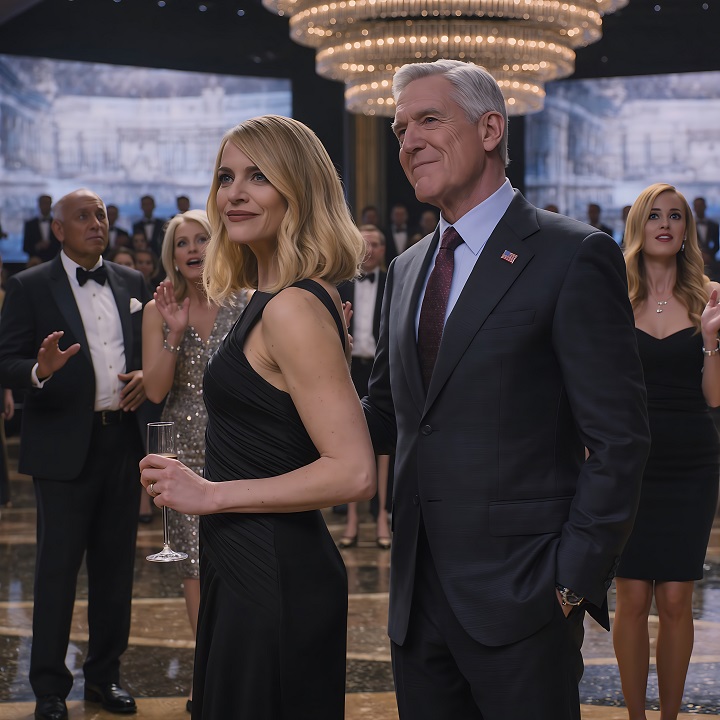
Three weeks after my sister “forgot” my plane ticket, she walked into a Beverly Hills ballroom tanned from her dream trip to Europe, spotted me standing beside a man in a navy suit with a tiny American flag pin on his lapel, and almost dropped her champagne.
Two hundred investors turned as her laugh died in her throat. Chandeliers glittered, a discreet Stars-and-Stripes stood framed in glass near the stage, and I smoothed the black Oscar de la Renta gown she once called “too dramatic for family.” My fingers brushed the edge of the one thing I’d slipped into my clutch that didn’t belong at a high-end launch party: a crumpled, blue-and-white boarding pass with my name on it. The seat I never got to use.
My sister, Lily, blinked like she was seeing a ghost. My adoptive mother, Diana, went pale under a thousand-dollar contour. Neither of them knew yet that the man with the flag pin had already signed the papers that put their $68 million empire in my hands.
Looking back, that was the exact second the Harrington family finally realized they’d left the wrong girl at the airport.
Hi, I’m Maya Garcia. I’m thirty-four, I live in Los Angeles, and this is the story of how one “glitched” plane ticket turned into the biggest takeover of my life. If you’ve ever felt like the outsider in your own family, like you were paying for a seat you never really got to sit in, you might hear more of yourself in this than you expect.
Let me take you back to the morning everything snapped.
The day of the trip started with the kind of hope I hadn’t let myself feel in years. June 15, LAX, Terminal 5. I’d been up since four a.m., triple-checking everyone’s passports, smoothing printed itineraries, sliding color-coded folders into my carry-on like I was packing a dream.
Five business-class tickets to Barcelona. Ten nights of five-star hotels. Private tours. Airport shuttles. Skip-the-line passes to every cathedral and rooftop in a forty-mile radius. I’d spent three months building the Harrington family’s perfect European vacation and $42,500 of my own money paying for it.
Forty-two thousand five hundred dollars. That number sat in my chest like a warm stone. It wasn’t just money; it was a promise I’d made to myself when Diana once sighed over the dishes and said she wanted to see Barcelona before she turned sixty.
“I’ll cover the whole thing,” I’d blurted. “Flights, hotels, tours, all of it.”
She’d protested for about four seconds. “Maya, that’s too much, honey—”
But I was already running the numbers in my head. Vice President of Corporate Strategy at Bayshore Equity Partners paid well. My student loans were long gone. I could afford it.
“Wow, Maya, you’re such a blessing,” she’d finally said when I emailed her the glossy PDF itinerary. Those five words felt like sunlight through a crack in a locked room. For a second, I almost believed I was more than the adopted girl who’d moved in at nineteen after my birth parents died in a car accident off I‑5.
At the check-in counter, I slid all five passports toward the agent with a little flourish. “The Harrington family is traveling together,” I said, and I meant every word.
That sentence felt like my boarding pass into belonging.
Lily appeared at my side, blonde hair somehow perfectly curled at six-thirty in the morning. She wore designer athleisure and that effortless, glossy confidence she’d been raised in.
“Maya, can I talk to you for a second?” she asked, already tugging me a step away while the agent typed.
There was something bright in her blue eyes I couldn’t quite read. Amusement? Pity? I ignored it. I wanted so badly for this to be good.
“This is so awkward,” she said, lowering her voice into that soft, faux-concerned tone she used on waitstaff and people she secretly looked down on. She pulled up something on her phone, face twisting theatrically. “I don’t know how this happened, but there’s a problem with your ticket.”
My stomach dipped. “What are you talking about? I booked everything together. I have all five confirmations right here.”
I held up my own phone, email thread open like a shield.
She shook her head and tapped her screen with a manicured nail. “No, look. Last week when I was organizing our seats and pre-selecting meals, I must’ve, like…ugh.” She sighed dramatically. “Maya, I’m so sorry. I think I accidentally canceled your seat. The system must have glitched.”
The agent called, “Next, please.”
My feet turned to concrete. The lights overhead went too bright, washing the terminal in a hard white glare. Diana rolled up with her designer carry-on and a tote with a tiny embroidered American flag in the corner, glancing between us with a practiced frown.
“What’s going on?” she asked. “We need to get through security.”
“It’s Maya’s ticket,” Lily said, eyes widening with perfect fake panic. “It’s not in the system. I think I accidentally canceled it when I was changing our meal choices.”
“Oh dear,” Diana murmured. It sounded less like surprise and more like she was reading off a cue card.
“Can’t we just buy another seat?” I asked, clinging to logic.
The agent checked again, her fingers flying across the keyboard. “I’m sorry, ma’am. This flight’s completely full. It’s been sold out for weeks. The next available seat to Barcelona is Thursday.”
Four days later. By then, they’d be halfway through tapas and cathedrals and rooftop selfies without me.
“Maya, you understand, right?” Lily squeezed my arm, just a little too hard. “We can’t all miss the flight. The hotel is nonrefundable. The tours are prepaid. You can always join us later.”
Behind her, my cousin Evan pretended to scroll his phone, suddenly very interested in nothing. Diana avoided my eyes so intensely it felt deliberate.
Right there in Terminal 5, with TSA announcements droning overhead and kids dragging cartoon-covered suitcases past my ankles, I shrank back into the eight-year-old version of myself who’d sat in a foster-care office clutching a trash bag of clothes, waiting to find out if anyone wanted her.
“Go,” I heard myself say. “Don’t miss your flight.”
Lily hugged me quickly, her body already turned away. “You’re the best, Maya. We’ll stream you from the Sagrada Família.”
I watched them walk toward security, their laughter carried back in broken pieces by the air conditioning. Not once did any of them look back.
That was the first hinge in the story: the moment I realized I had paid $42,500 to be reminded exactly where I ranked.
The rideshare home was the longest forty minutes of my life. The driver had a tiny flag air freshener hanging from the mirror that kept tapping the windshield with every bump. The red, white, and blue swung back and forth while my phone lit up with the Harrington Barcelona group chat.
Lily clinking glasses of sparkling wine at the gate.
Diana posting a shot of her reclining business-class seat with the caption, “Finally living my dream. Thank you, God.”
Evan joking about extra leg room now that “one of the kids” wasn’t going.
Not one message asking if I was okay.
Back in my Santa Monica apartment—a sunlit, quiet space I’d bought mostly so I’d have somewhere to breathe away from the constant pull of the Harrington house—I dropped my bag on the couch and just…stood there.
Silence pressed in, the kind you pay a lot of money for in L.A. Usually I loved it. That afternoon it felt like the echo after a slammed door.
My phone buzzed with a memory notification from FriendConnect. One year ago today: Harrington family Thanksgiving.
I opened it.
There they were. Twelve people around a beautifully set table, crystal glasses catching candlelight, Diana at the head, Lily mid-laugh.
I wasn’t in the photo.
Of course I wasn’t. I’d been the one taking it.
Another memory: Lily’s graduation. I’d been introduced to her friends as “a close family friend who’s been very generous.” When Charles’s mother passed, the obituary listed every grandchild—except me.
“It would just be confusing to explain,” Diana had said lightly when I noticed. “You understand, don’t you?”
For fifteen years, my value in the Harrington story had been mostly numerical. I was the safety net with a smile.
My degree from Stanford Graduate School of Business, earned while working full-time to support myself? No space for that on the mantle.
When I became the youngest VP of Corporate Strategy in Bayshore’s history, Diana’s response was, “That’s nice, dear. Speaking of money, do you think you could help with Lily’s car insurance?”
Even my birth name had become a ghost. Legally, I was Maya Harrington. Emotionally, I was the live-in sponsor.
I’d told myself for years that family doesn’t keep score.
That night, for the first time, I opened a spreadsheet and did.
I added the $260,000 I’d quietly used to pay off the remaining mortgage on the Harrington family home when the market dipped and Charles’s construction business tightened. The $95,000 in Lily’s student loans I’d erased without asking her for a penny back. The $62,000 Lexus SUV I’d bought for Diana after her accident, pretending it was a great lease deal so she wouldn’t feel awkward.
Then I typed in the number that suddenly felt like a punchline: $42,500 for a European vacation I wasn’t on.
Finally, the big one: $6,200,000. The amount of my own savings I’d invested in their flagship development, Harrington Crest Pavilion, a $68 million mixed-use project in Silverwood, just outside downtown L.A.
In total, over fifteen years, I’d poured roughly $8.6 million into a family that still introduced me as “kind of like a niece.”
The hinge sentence that came next hurt more than any number: I realized I had paid for the chair they kept pulling out from under me.
Three days into their trip, I muted the Barcelona chat. I didn’t stop working. If anything, I buried myself in it.
At Bayshore’s office, high above downtown, I pulled up the digital files for Harrington Crest. Two years earlier, when they’d decided they were finally going to build a real estate dynasty, they’d turned to me for help structuring the financing.
It was funny. To them, I was the charity case. To everyone else in my industry, I was the person you called when you needed to stack capital, minimize risk, and thread needles through impossible deals.
They’d signed whatever I handed them. They trusted that I knew what I was doing.
They just never thought about what that actually meant.
Staring at the spreadsheets and contracts now, I saw something that would have slipped past most people but leaped out to me: a vulnerability in the funding structure that looked a whole lot like a countdown clock.
If their primary outside investor ever pulled out, they’d have forty-eight hours to replace roughly $27 million or watch the whole project slide into default.
That’s when my phone rang.
Unknown number.
“This is Maya,” I answered, automatically smoothing my blazer even though no one could see me.
“Ms. Garcia,” a warm, composed voice said. “This is Nathaniel Rhodes. I believe we met briefly at the Bayshore Summit last fall.”
My heart kicked. Nathaniel Rhodes—founder and CEO of Rhodes Capital Group. His firm owned what felt like half of downtown Los Angeles and a generous slice of the West Coast skyline.
We’d spoken for maybe five minutes at a networking dinner. Long enough for him to make a dry joke about debt covenants and for me to notice that he listened more than he talked.
“I’m calling about an investment opportunity I think might interest you,” he continued. “Specifically, a project called Harrington Crest Pavilion.”
My fingers froze on the keyboard. “I’m familiar,” I said carefully.
“I heard through the grapevine that you structured the original deal,” he said. “It’s smart work. Flawed, but smart. I’d like to buy you coffee and talk about it.”
Somewhere in the background, I heard the faint clatter of dishes, that hotel-lobby hum. “I’m available all week,” I said. “My family is…out of town.”
“In Europe without you,” he said gently. “Yes, I heard.”
Heat crawled up my neck. “Something like that.”
“Well,” he replied, “from what I’ve seen, that’s their loss, not yours. Tomorrow, two p.m., the Waldorf Beverly Hills?”
I stared at the spreadsheet of numbers that represented my entire history with the Harringtons. “I’ll be there.”
If you’ve ever felt like the extra person in your own story, like you’re useful but never central, type “me too” in your head right now. I didn’t know it yet, but that meeting was about to rip the script out of their hands and put it in mine.
The Waldorf’s lobby smelled like polished wood and citrus. I sat across from Nathaniel in a velvet chair, fingers wrapped around a coffee I barely tasted as he slid a folder across the table.
“Maya, I’ll be direct,” he said. “Your family is about to lose everything tied to Harrington Crest.”
I opened the folder.
Inside were financial statements, email printouts, redlined contracts, and one name highlighted in thick yellow.
Lily Harrington, Managing Director.
“The project is over-leveraged against loans they cannot possibly repay without their primary investor,” Nathaniel explained, calm as if we were discussing weather. “That investor is pulling out next week.”
My stomach dropped. “Why?”
“Because of this.” He tapped the page. “Your sister has been siphoning money from the project for over a year. Small amounts at first. In the last six months it’s added up to about $2.6 million in bogus vendor payments routed through shell companies she controls.”
Transaction after transaction filled the pages. Fake companies. Fake invoices. Real money.
While I’d been paying for trips and tuition and safety nets, Lily had been skimming from the one project that carried my money and my professional reputation.
“The primary investor discovered the pattern yesterday,” Nathaniel said. “They intend to go public with it at the launch gala. Unless someone with deeper pockets steps in to cover the losses and take over the project.”
He leaned back and studied me. “Rhodes Capital is prepared to do that cleanly, legally, and very publicly.”
“Why are you telling me?” I asked.
“Because I’ve been watching your career for years,” he said simply. “You’re good. Very good. And you’ve been financially propping up people who don’t seem to value you. I’m offering you a choice: let them implode and take your $6.2 million with them, or help me acquire the project in a way that protects innocent investors, salvages what matters—and gives you thirty percent equity in Rhodes Capital Group in the process.”
I blinked. “Thirty percent?”
“That’s more than they ever would have left you,” he said, not unkindly.
I thought about the $6.2 million of my savings tied up in Harrington Crest. Money that would vaporize in a scandal. Money that had bought me a folding chair at their table, apparently near the exit.
“If I say yes,” I asked slowly, “they can never know it was me. Not until the launch. Not until they say out loud what they already believe.”
Nathaniel’s mouth curved. “That’s exactly what I was hoping you’d say. I need someone they trust, someone close enough to shepherd the legal process through. Someone they’d never suspect, because they’ve spent years underestimating her.”
I exhaled. “I’m in.”
That agreement was the third hinge of the story: the moment I stopped being their safety net and started being my own.
The confrontation came faster than I expected.
That night, my phone lit up with a call from a number I didn’t recognize, but the tone was pure Lily.
“Did you meet with Nathaniel Rhodes?” she demanded as soon as I answered.
I kept my voice even. “I have a lot of meetings, Lily. That’s my job.”
“Don’t play dumb,” she snapped. “Someone saw you at the Waldorf. He’s been sniffing around Harrington Crest. If you said anything—”
“Anything about what?” I asked. “No one told me you were even back from Barcelona. I had to find out from PickStream.”
“We got back yesterday,” she said flatly. No apology. Just a scheduling update. “Look, we need you at the launch. Investors want to see a united family. Smile for the cameras, answer a few questions in finance language, you know the drill.”
The audacity almost made me laugh. They’d left me at LAX like forgotten luggage. Now they wanted my face on their stage.
“I don’t think so,” I said.
“Excuse me?” Her tone sharpened instantly.
“I’m not coming, Lily.”
“You ungrateful—” She cut herself off, then regrouped. “Maya, you owe us. We took you in. We gave you our name, a home, everything.”
My hand tightened on the phone. “And I gave you $260,000 for the house,” I said quietly. “$95,000 for your loans. $42,500 for a trip you conveniently ‘forgot’ to include me in. $62,000 for Mom’s car. And $6.2 million for Harrington Crest.”
“You offered that money,” she shot back. “Call it rent for eighteen years of charity.”
The word charity burned.
“Charity?” I repeated.
“You heard me,” she said. “If you don’t show up, don’t bother coming to anything else ever again. Holidays, birthdays, weddings. You’re either with the family or you’re out.”
“I understand,” I said.
“And that money you mentioned?” Her voice turned icy. “Consider it backpay for what you cost us.”
She hung up.
I stared at the email from Nathaniel’s team in my inbox—draft agreements, equity breakdowns, the path out of the Harrington gravity well laid out in black and white.
One signature, and I’d be a major partner at Rhodes Capital Group.
One signature, and they’d lose everything built on my back.
I picked up my pen.
Diana’s call came at midnight. Of course it did.
“Maya, sweetheart,” she cooed, sugar in every syllable. “Lily told me about your little meltdown.”
“It wasn’t a meltdown,” I said. “It was clarity.”
“You’re being dramatic,” she murmured. “We forgot your plane ticket. It was a mistake.”
“Was it?” I asked.
Pause.
“What are you implying?”
“I’m done funding people who treat me like a walking tax deduction,” I said. My voice surprised even me with how calm it sounded.
“How dare you talk to me like that?” she snapped. “After everything we’ve done for you.”
“Did Lily tell you she thinks I’ve been talking to Rhodes about the project?” I asked.
“I don’t care who you’ve been talking to,” she hissed. “That is family business. You are not family.”
There it was. Clean. Sharp. Unedited.
“Lily made that pretty clear, too,” I said softly.
“You’re twisting things,” Diana said. “We love you, but you need to understand your place. Charles is gone. The Harrington legacy belongs to blood. The only reason you’re even in this conversation is because we’re generous.”
“My money was good enough for that legacy,” I said. “$6.2 million good enough.”
“That was a gift. You can’t take it back.”
“I’m not taking anything back,” I replied. “I’m just done giving.”
“If you don’t show up to the launch,” she warned, “you’re out. No holidays, no birthdays, no Harrington events. And everyone will know you abandoned the family that saved you.”
I looked at the Rhodes contract spread across my desk, at the signature line waiting for my name.
“Diana, can I ask you something?” I said.
“What?”
“In all the years I lived under your roof, sat at your table, paid your bills…did you ever actually love me? Not what I did for you. Me.”
Silence stretched so long I could hear her breathing.
“Love doesn’t pay bills, Maya,” she said at last, voice like ice. “You of all people should know that.”
When the call ended, I signed every document Nathaniel had sent.
Then I blocked every Harrington number in my phone.
That’s the thing about boundaries: the people who hate them the most are usually the ones who benefited from you having none.
Two days before the launch, I was reviewing one last stack of Harrington Crest documents when I found the line that changed everything again.
Buried deep in the dense legal language I’d drafted two years earlier, clause 12A. A little insurance policy I’d slipped in after a late-night call with Charles, back when he was sick and scared and more honest than he’d ever been.
In the event of fiduciary misconduct by any managing partner, their shares automatically transfer to the largest individual investor.
My eyes flew to the cap table.
The largest individual investor was me.
I called Nathaniel immediately.
“You need to see this,” I said.
Twenty minutes later, he was in my office, laughing so hard his assistant stuck her head in to make sure he was okay.
“Maya, do you realize what this means?” he asked.
“That technically, I already own Lily’s forty percent,” I said. “Which makes me the majority owner.”
“The acquisition isn’t strictly necessary,” he agreed. “You could walk in and take the project today.” His smile turned sharp. “But they don’t know that. And if we handle this carefully, they’ll sign away their remaining shares thinking they’re saving themselves, when all they’re really doing is signing them to you.”
We spent the next hour reworking paperwork. To the outside world, Rhodes Capital would still look like the savior firm stepping in. My name would live quietly in the subsidiary documents—the ones no one on their side would bother to read.
“Oh,” Nathaniel added as we wrapped up. “One last thing. I want you to wear something unforgettable tonight. Something that says you’re not here as anyone’s charity case.”
“I have the perfect dress,” I said. “An Oscar de la Renta gown I bought for Charles’s funeral. Diana said it was too much for a family event.”
He smiled. “Sounds perfect for a different kind of family event. And on stage, when I introduce you, how would you like to be announced?”
For years, I’d been introduced as an afterthought. A plus-one. A very generous family friend.
“Call me what I actually am,” I said. “The woman who owns the Harrington legacy.”
Have you ever had that quiet, shocking moment where you realize you’ve been holding the winning card the whole time? If you have, you know exactly how it felt to slide that crumpled boarding pass into my clutch the night of the launch, a reminder of the seat they thought they took from me.
The Four Seasons Grand in Beverly Hills glittered like a movie set. The ballroom hummed with the low roar of money—laughter, clinking glasses, the soft shuffle of designer shoes. Two hundred of California’s wealthiest investors and socialites moved under crystal chandeliers.
Diana was already on stage when Nathaniel and I walked in, her voice smooth over the sound system.
“…this project represents everything our family stands for,” she was saying. “Heritage, stability, exclusivity.”
At the back of the room, a discreet American flag stood framed in glass beside a display of architectural renderings, like a reminder that this was still, technically, a country where actions had consequences.
As we stepped into the light, her gaze snagged on us. Her smile wobbled.
Lily, standing near the edge of the stage in a champagne-colored gown, went white beneath her spray tan.
She leaned toward Diana, hissing something into the dead zone of the mic. Diana stiffened, then pasted on her society smile.
“Ladies and gentlemen,” she continued, voice suddenly tight around the edges, “the Harrington family has always been very selective about who we bring into our inner circle. Bloodlines and loyalty matter. Not everyone who passes through our lives is truly family. Tonight we celebrate with those who’ve earned their place.”
Her eyes locked on mine for that last sentence.
My hands went still in my lap.
Lily stepped forward and took the mic. “Before we continue,” she said, voice trembling just enough to look sincere, “I want to address something. There’s a woman here tonight who doesn’t belong at this event.”
The room hushed instantly.
“Maya Garcia might use our last name,” Lily said. “But she is not a Harrington heir. She’s not blood. She’s not family. She’s someone we graciously took in, who’s now trying to insert herself where she has no place.”
Security started moving toward me.
It took everything in me not to laugh.
Nathaniel rose before they reached us. “Actually, Ms. Harrington,” he said, his voice carrying easily, “she’s with me.”
The guards stopped. Rhodes Capital money carried more weight in that room than any last name.
“Nathaniel,” Diana said, composure cracking. “We weren’t expecting you tonight.”
“Clearly,” he replied. “Which is surprising, given that Rhodes Capital is about to be very involved with Harrington Crest Pavilion.”
A low murmur rippled through the crowd.
“What are you talking about?” Lily demanded.
“Perhaps you should ask your accountants about the $27 million gap in your funding,” Nathaniel said lightly. “Or the $2.6 million in vendor payments made to companies that don’t exist. I’m sure the investors here tonight would be very interested in those details.”
Gasps. Heads turned. Phones appeared.
“That’s slander,” Lily shrieked. “Maya, you vindictive—”
“Ms. Harrington,” Nathaniel cut in, turning the room’s attention back to him with one sharp look. “Maya hasn’t said a word. I’m the one speaking. Though I am curious why you assumed she was involved.”
Lily had just admitted on microphone that she knew about the siphoned funds.
The trap snapped shut all by itself.
“Security, remove them,” Diana barked, pointing at us. “This is our event.”
The security chief shifted uneasily. “Ma’am, Mr. Rhodes is a major shareholder in this hotel. We can’t.”
“I am a Harrington!” Lily screamed. “This is my launch. She is nobody. She’s a charity case.”
A charity case who paid off your mortgage.
I stood, my legs surprisingly steady. “Who covered your loans, Lily?” I asked, my voice carrying without a mic. “Who invested $6.2 million in this project while you were bleeding $2.6 million out of it?”
“You can’t prove anything,” she said, but the fear in her eyes betrayed her.
I pulled out my phone and tapped into the ballroom’s AV system, a feature I’d insisted on when I helped book the venue.
The renderings of Harrington Crest on the giant screens behind them flickered, then dissolved.
In their place: transaction histories, bank records, shell company registrations, copies of Lily’s forged signatures.
“I don’t have to prove it,” I said quietly. “You already did.”
The room went dead silent except for the rapid clicking of camera shutters.
“Turn it off!” Diana screamed. “Turn it off now!”
No one moved.
Nathaniel walked up the steps to the stage with the steady confidence of someone who’d spent his life in rooms like this. The crowd parted for him instinctively.
“Ladies and gentlemen,” he said into the microphone, “I apologize for the interruption. Transparency is nonnegotiable in honest business. Rhodes Capital Group has been monitoring the Harrington Crest situation for some time.”
He clicked a remote. The screens shifted to show Rhodes Capital’s logo beside acquisition documents.
“As of nine a.m. this morning, Rhodes Capital has acquired all outstanding debts and liens connected to Harrington Crest. Practically speaking, we control the asset.”
The ballroom erupted.
“You can’t do this!” Diana cried.
“We have contracts with a morality provision,” Nathaniel said smoothly. “Clause 12A, to be precise. In the event of fiduciary misconduct by any managing partner, their shares automatically transfer to the largest individual investor.” He paused. “Would you like to know who that investor is?”
Lily shook her head slowly, as if she could deny reality by refusing to hear it.
“No,” she whispered. “No, it can’t be—”
“Maya Garcia,” Nathaniel announced, turning toward me, “who personally invested $6.2 million and holds thirty-one percent of the project. Combined with the forty percent that transferred from Ms. Harrington pursuant to her misconduct, Maya now owns seventy-one percent of Harrington Crest Pavilion.”
Reporters surged forward. Investors shouted questions. Somewhere in the back, someone actually said, “Oh my God,” out loud.
“But she’s not even family!” Lily shouted, pointing at me. “Tell them, Mom. Tell them she’s nobody.”
Nathaniel smiled without warmth. “She’s somebody now,” he said. “In fact, she’s your landlord, your employer, and the owner of everything you thought was untouchable.”
He offered me the microphone.
I walked onto that stage with fifteen years of swallowed humiliation holding my spine straight.
“Good evening,” I said. My voice sounded steadier than I felt. “I know many of you are confused, so let me clarify who I am.”
I looked straight at Diana and Lily.
“Yes, I came into the Harrington home as a child who needed somewhere to go after my parents died,” I said. “They gave me a roof. I gave them $260,000 for that roof.
“They gave me their last name on paper. I gave them $95,000 for school, $62,000 for transportation, $42,500 for the vacation that left me standing at LAX, and $6.2 million for this project.”
A low murmur rippled through the crowd.
“You taught me something,” I continued. “You taught me that love doesn’t pay bills. You were right. But respect does. Integrity does. And those are currencies you never learned how to hold.”
The room was so quiet you could hear ice settling in glasses.
“Effective immediately,” I said, “Lily Harrington is removed from any role or authority connected to Harrington Crest Pavilion. Diana Harrington’s consulting agreements are terminated. All Harrington family members are banned from the property.”
“You can’t do this,” Diana whispered. “Charles would be spinning in his grave.”
“Actually,” I said softly, “Charles helped me write clause 12A.”
Her head snapped up. “You’re lying.”
I pulled a folded letter from my clutch, the paper worn at the creases. “Should I read what he wrote?” I asked. “About how he knew you and Lily planned to cut me out of everything? About how he insisted we build a protection into the structure?”
Nathaniel took the mic again. “And there’s more,” he said. “Maya isn’t just the majority owner of Harrington Crest Pavilion. She is also the newest equity partner at Rhodes Capital Group, holding thirty percent of our overall portfolio.”
You could feel the math ripple through the room. Rhodes Capital wasn’t a boutique firm; it was a multibillion-dollar powerhouse. Thirty percent made me one of the wealthiest women in California overnight.
“That’s impossible,” Lily said weakly. “She’s just…she’s just good with spreadsheets.”
“The youngest VP of Corporate Strategy in Bayshore’s history,” Nathaniel corrected. “Stanford Graduate School of Business honors graduate. The strategist who quietly held your family together while you were bleeding it dry.”
Questions flew at me—about renaming the project, about Rhodes Capital’s expansion, about future acquisitions—but my attention was locked on the two women who had spent fifteen years reminding me how lucky I was to be under their roof.
“The saddest part?” I said into the mic. “I would have given you everything freely, lovingly, for as long as I lived. All you had to do was actually make me family. Not in legal documents. In your hearts.”
I held up the stack of papers Nathaniel’s team had prepared, the ones the Harringtons had just signed in their panic.
“But you chose greed,” I said. “You chose cruelty. So now you get to live with those choices.”
“Please,” Diana said suddenly, tears streaking her mascara. “Maya, please, we’re sorry. We’re family.”
“No,” I said, my voice clear and steady. “You’ve told me very clearly what I am and what I’m not. I’m just finally listening.”
Security moved toward Lily with a box—her desk contents, already packed.
“You planned this,” she said, voice shaking. “You’ve been planning this for years.”
“No, Lily,” I said. “You planned this the day you ‘accidentally’ canceled my ticket. When you laughed at the airport. When you spent my money and called it rent. That was you.”
Nathaniel’s attorney, Melissa Kent, stepped forward with the final documents.
“Ms. Harrington,” she said to Diana, “this acknowledges the change in ownership and transfers your remaining interest to Maya. If you refuse to sign, we’ll proceed with criminal charges for fraud. $2.6 million is well within the federal threshold.”
Diana’s hand shook as she signed. Lily’s signature came next, her tears smudging the ink.
“With each signature,” Melissa said, “you relinquish your claim to Harrington Crest Pavilion and its income streams.”
“And the penthouse?” Diana asked, small and broken.
“You have thirty days to vacate,” I said. “That’s more generous than I’m required to be.”
“Where are we supposed to go?” she whispered.
“You could always use some of that Barcelona money on a rental,” I replied. “Oh, wait. That was mine, too.”
The room ate it up. Every second was being captured on phones that would replay this twenty different ways by morning.
Nathaniel lifted a champagne flute. “A toast,” he said. “To Maya Garcia, who just proved that family isn’t blood. It’s character.”
The applause rolled over me like a wave.
But I wasn’t done.
“One more thing,” I said, taking back the mic. “The $6.2 million I invested in Harrington Crest? It’s not going back to me. Every cent is being donated to the Future Horizon Scholarship Trust to fund education for kids aging out of foster care.”
This time, when the crowd erupted, it sounded different. Warmer.
In the corner, Diana sat down hard, as if she’d finally understood that this wasn’t just about money. It was about the story behind the money. The legacy.
“Lily, please,” she said, grabbing her daughter’s wrist. “Say something. Fix this.”
Lily tried one last time. “Maya, please,” she said, voice breaking. “We’re sisters.”
“No,” I said. “We’re not. Sisters don’t leave each other at airports. Sisters don’t call eighteen years of survival ‘rent.’ Sisters don’t erase each other from every story.”
I slipped my hand into my clutch and felt that useless boarding pass, edges soft from being folded and unfolded. For the first time, it didn’t feel like proof that I’d been left behind.
It felt like proof that I’d finally changed destinations.
Outside, under the porte cochère, Nathaniel’s Aston Martin idled, headlights washing the curb in clean white light. As we walked toward it, I felt someone grab my arm.
Diana.
“You ungrateful little—”
“Remove your hand,” I said calmly, loud enough for nearby security and a couple of lingering reporters to hear, “or we add assault to the list.”
She dropped it.
“I gave you everything,” she hissed. “A home, a name, a family.”
“You gave me a roof in exchange for roughly $8.6 million over fifteen years,” I replied. “You gave me a name you wouldn’t put on a Christmas card. You gave me a family that made sure I never forgot I was an outsider.”
Lily stood beside her, mascara tracks cutting down her cheeks.
“Fine,” she said hoarsely. “We’re sorry. I’m sorry. Are you happy?”
“I don’t want anything from you,” I said. “And that’s what you never understood. I didn’t spend all that money because I owed you. I did it because I loved you. I wanted to belong. You turned that into a transaction.”
I pulled one last envelope from my clutch.
“This is a restraining order,” I said. “You come within five hundred feet of me, any of my properties, or any Rhodes Capital sites I manage, and you will be arrested. All communication goes through lawyers from now on.”
“After everything we did for you,” Diana whispered.
“In fifteen years,” I said, making sure every microphone nearby caught it, “I paid you roughly $25,000 a month for the privilege of being your charity case. So tell me, Diana—who was really saving who?”
Nathaniel touched my elbow gently. “The car is waiting,” he said.
As we pulled away, ballroom lights receding in the rearview mirror, her last words echoed in my head.
“You’ll regret this. Family is forever.”
I watched the city blur past, streetlights streaking across glass like lines on a ledger.
“No,” I murmured. “Family is a choice. And you chose wrong.”
The fallout was fast and merciless.
By morning, every business site and gossip feed carried some version of the story.
Adopted daughter takes over Harrington empire.
From charity case to power partner: the Maya Garcia story.
Embezzlement, betrayal, and a surprise majority owner at Beverly Hills launch.
The Federal Financial Crimes Bureau opened a formal investigation into Lily’s activities. Her accounts were frozen. Firms that had been courting her for “glamorous leadership roles” quietly withdrew their offers. No one wanted their brand trending next to the word fraud.
Diana resigned from the charity boards she’d spent decades flaunting. The country club revoked her membership after other members complained about “reputational risk.” Friends who had clinked glasses with her over bottomless brunches stopped returning her texts.
Evan sent me a voice note.
“Maya, I had no idea they were treating you like that,” he said. “If I’d known—”
“You knew,” I said to my empty kitchen as I deleted it. A little flag magnet on my fridge—a souvenir from a Fourth of July barbecue years back—caught my eye, red and blue faded from too many cleanings. “You just didn’t care until it cost you something.”
Harrington Crest Pavilion was renamed Rhodes Summit Plaza. The portrait of Diana that had been planned for the lobby was replaced with a photograph of graduates from the Future Horizon Scholarship Trust: former foster kids in caps and gowns, smiling like they’d broken a curse.
Within a month, Diana and Lily were living in a small two-bedroom on the edge of the Valley. Their luxury cars were repossessed. Their cards were declined. The Barcelona photos that once filled their feeds now looked like artifacts from a life they’d rented on someone else’s dime.
The inheritance they’d tried so hard to keep away from me—Charles’s estate—turned out, once Rhodes’s lawyers dug through the paperwork, to be mostly debt. Debt I’d unknowingly been helping offset for years.
Without my money, the Harrington name didn’t buy much.
I gave exactly three interviews: one to Prospect Weekly, one to The Financial Ledger, and one to a youth-empowerment podcast focused on kids who’d grown up in foster care.
“What would you say to someone who feels like they’ll never really belong anywhere?” the podcast host asked.
“You belong to yourself first,” I said. “No one else gets to define your value. Not a last name. Not a bloodline. Not a bank account.”
That episode went viral. Messages poured in from adoptees, foster kids, people who’d been treated like the walking charity project in their own families. Their stories broke my heart and strengthened my spine at the same time.
Meanwhile, the investigation into Lily uncovered that Harrington Crest wasn’t the first time she’d skimmed. Civil suits piled up. Criminal charges followed. Her lawyer—the same man who had once helped structure documents meant to push me out—dropped her when she couldn’t pay.
Diana tried to sell a tell-all manuscript about “raising an ungrateful adopted child.” No reputable publisher would touch it. She set up a crowdfunding page claiming I had stolen her legacy.
It collected $387 before the platform shut it down for misrepresentation.
Six months later, an envelope arrived at my office. No return name, but I recognized the handwriting.
Maya,
You’ll probably throw this away, but I need you to know we were wrong. I was wrong. Not just about the money or the trip. About everything. You were the only real thing in our fake family. The only one who actually loved us, and we threw you away.
I’m sorry. I know it’s too late, but I am.
Lily
I didn’t respond.
Some bridges, once burned, become the light you use to find your way out.
Over the next three years, Nathaniel and I became partners in more than one sense. We co-led developments that rebuilt old spaces in ways that actually served the communities around them. The financial press dubbed us “the duo reshaping the West Coast skyline.” We laughed about it over coffee, then went back to our spreadsheets.
More importantly, we built something I’d never really had before: chosen family. People who showed up when it mattered, who said hard things gently, who saw me as more than my résumé or my bank account.
Rhodes Summit Plaza thrived. I restructured tenant agreements to bring in minority-owned businesses, added affordable units alongside the luxury condos, and built mentorship space for Future Horizon scholars right into the design.
The Future Horizon Scholarship Trust had distributed over $2.4 million in grants by the time I turned thirty-seven. I personally mentored five young women aging out of foster care, helping them navigate admissions, interviews, and that strange, hollow ache of feeling unanchored.
They called me their chosen big sister.
It meant more than “Harrington” ever had.
Lily eventually pled out. She got five years in prison, with the possibility of reduction for good behavior. Diana took two buses every week to visit her at the correctional facility.
One afternoon, Nathaniel slid an envelope across my desk at Rhodes Capital headquarters, high above the city.
“I knew Charles before he got sick,” he said. “He talked about you.”
“He never said much to me,” I replied, staring at the envelope. “Not about this, anyway.”
“He didn’t say it,” Nathaniel said. “He wrote it.”
Inside was a letter in Charles’s unsteady handwriting.
My dearest Maya,
If you’re reading this, it means you finally saw what I always knew. You were never the charity case. We were.
Love,
Dad
For the first time since the airport, I cried. Not from hurt, but from something that felt like release.
Today, three years after that morning at LAX, I stand in my office at Rhodes Capital. Floor-to-ceiling windows frame a city I helped reshape. In the distance, Rhodes Summit Plaza catches the late afternoon sun.
On the wall behind my desk hangs a simple black frame. Inside, under museum glass, sits that blue-and-white boarding pass with my name on it—the seat they thought they’d taken away, the hinge that swung the whole story open.
It’s not a monument to revenge.
It’s a reminder that sometimes, the closed gate isn’t the end of your journey. It’s just the wrong terminal.
I’ve learned three truths I wish someone had told me when I was eight, sitting in that foster office under a faded poster of the American flag, hoping any family was better than none.
First: when people show you who they are, believe them the first time. The Harringtons showed me for fifteen years that my value was mostly numerical. I just kept resubmitting the same assignment, hoping for a different grade.
Second: you cannot buy your way into belonging. All the tuition checks, mortgages, cars, and vacations I covered only taught them I would pay for crumbs. They didn’t earn my love, but I let them rent it at a discount.
Third: the best revenge isn’t revenge at all. It’s building a life so full that their absence stops feeling like a wound and starts feeling like air. I didn’t destroy them. I just stepped out of the role they wrote me into and let consequences catch up.
In a strange way, leaving me at the airport was the kindest thing they ever did. It ripped off the last layer of denial and set me free.
If you’re still listening to this, and you’ve been someone’s charity case, someone’s ATM, someone’s afterthought, hear me: your worth is not defined by how much you give to people who never give back. Blood doesn’t make a family. Choice does. Respect does. Love does.
The Harringtons never chose me.
So I chose myself.
And that made all the difference.
If this story hits something in you, take a second—right now—to choose yourself in one small way. Close a tab, say no to a lopsided favor, open a spreadsheet and finally put numbers to a feeling. And if you feel safe sharing, tell someone, somewhere, about the moment you realized you were allowed to walk away.
Because your story might be the boarding pass someone else needs to finally stop begging for a seat and start booking their own flight.